
Scaling a catheter program is not simply about increasing production volume. It is about increasing maturity across four critical areas: device design, manufacturing process, quality system, and cost structure.
Most catheter programs move through three distinct phases:
- Prototype
- Pilot production
- Full-scale production
Each phase serves a distinct purpose. When expectations are aligned with that purpose, catheter scale-up becomes predictable, controlled, and economically sustainable.
At Medical Murray, we view scaling as a structured progression, not a single leap.
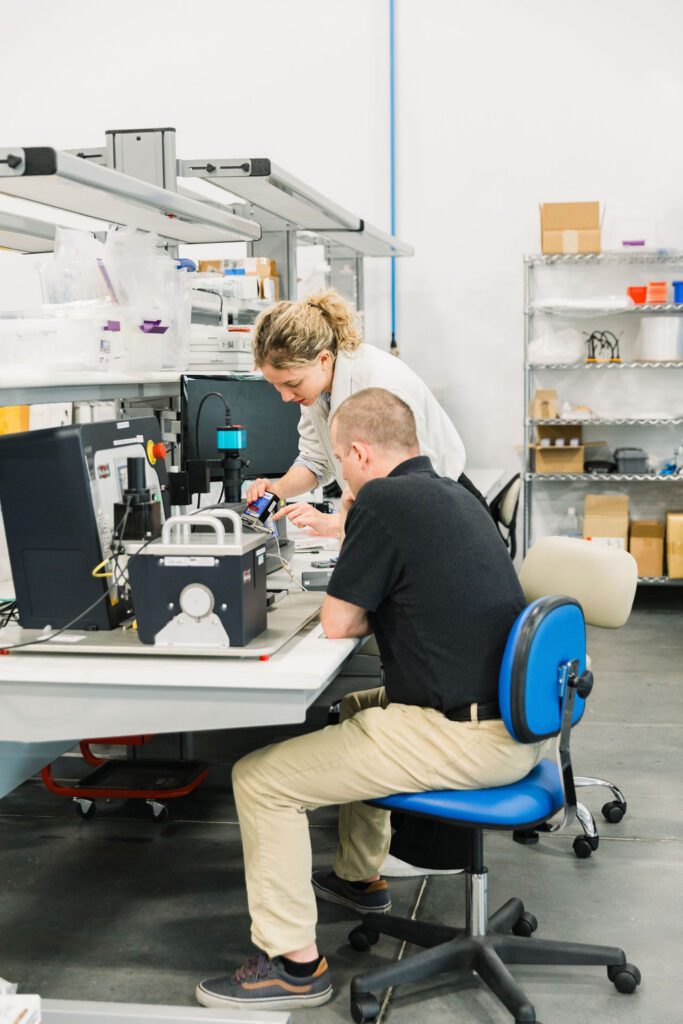
Prototype: Proving Performance
The prototype phase in catheter development is focused on technical feasibility and functional performance. Can the device deliver, deploy, inflate, steer, or seal as intended? During this phase:
- Builds are typically manual.
- Engineering involvement is high.
- Iteration cycles are rapid.
- Shaft constructions and reinforcement strategies are refined
- Bonding methods and material selections are evaluated.
The objective is learning and concept validation. At this stage, efficiency and cost are secondary.
Eventually, however, the question shifts from “Does it work?” to “Can it be built reliably and economically?”
DFM and Process Development: Aligning the Design with Commercial Reality
As a catheter program matures, Design for Manufacturability (DFM) and process development become critical to long-term commercial success.
This is where repeatability is engineered into the product.
Activities typically include:
- Refining tooling and fixtures
- Tightening process parameters
- Standardizing operator workflows
- Measuring and improving yields
- Identifying scrap drivers
- Reducing variability
- Modeling cycle times
Ideally, substantial DFM and process development occur before Design Verification (DV), so that DV validates the commercial-intent design and manufacturing approach, not just a functional prototype version.
Why DFM Before DV Matters
There is also an economic reason for this sequencing. DFM and process development are where cost of goods (COGS) is largely determined. Decisions around material utilization, automation level, bonding techniques, inspection strategy, and yield stability directly impact margin.
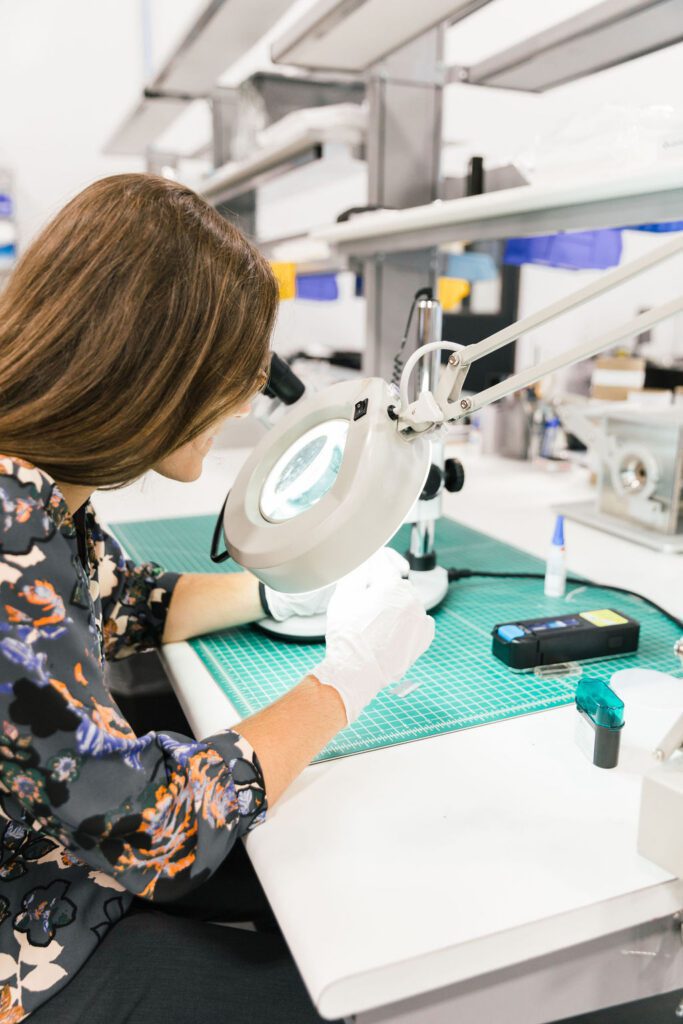
If DV is completed before manufacturing processes are sufficiently mature, the verified design may later prove more labor-intensive or scrap-prone than originally anticipated. At that point, meaningful improvements could require:
- Requalification
- Additional verification testing
- Regulatory documentation updates
In practice, however, many programs move into DV earlier than ideal. Clinical entry, regulatory milestones, and investor funding triggers often drive accelerated timelines. That is common and understandable in early-stage medtech.
The important thing is not avoiding that path; it is recognizing the tradeoffs.
Experienced catheter CDMOs plan documentation, validation strategy, and risk management (ISO 13485 and ISO 14971 frameworks) with both regulatory and commercial realities in mind.
Pilot Production: Real-World Validation
Following DV, most catheter programs enter pilot production rather than full-scale production.
Pilot production supports:
- Clinical trial builds
- Design validation activites
- Limited market release
- Process validation (IQ/PQ/OQ)
- Sterilization validation
This is often where the product encounters meaningful real-world use. Clinical experience can reveal subtle refinements, e.g. improvements to delivery feel, flexibility, tip geometry, or usability. These insights are part of the normal maturation of a device.
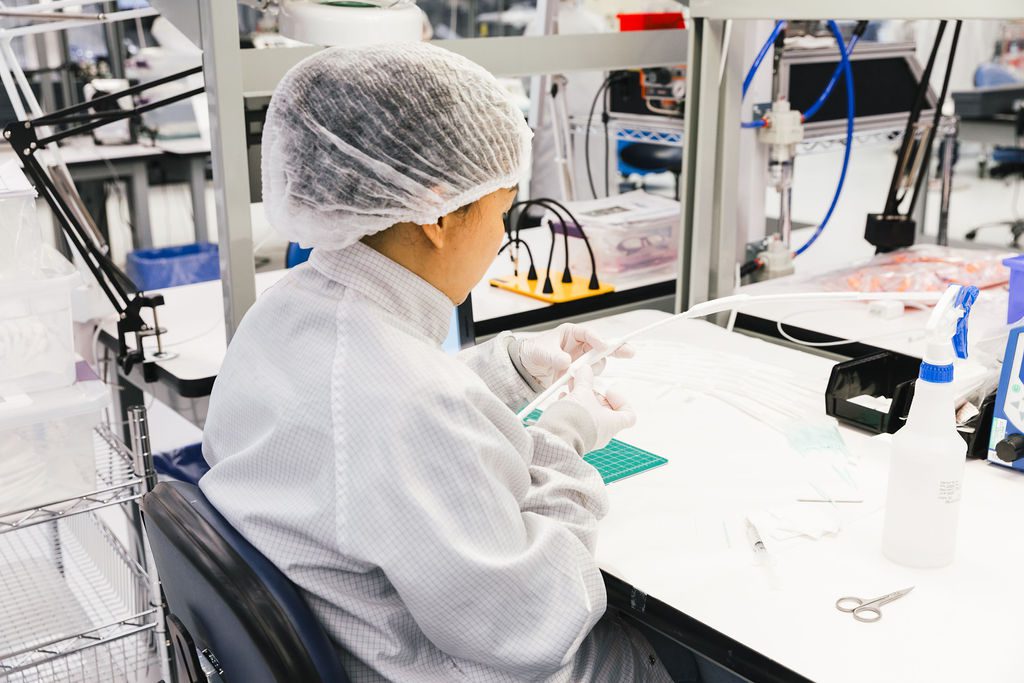
When improvements are identified, process requalification and selective re-verification may be required. Well-managed pilot programs anticipate this possibility and structure documentation and validation plans accordingly.
Pilot production also provides real data on yields, labor content, sterilization efficiency, and supplier performance. COGS projections are tested against actual performance. This phase often confirms whether earlier DFM decisions successfully aligned the design with commercial viability.
After multiple stable pilot lots and growing clinical confidence, the product is typically ready for transfer to full-scale production.
Full-Scale Production: Controlled Scale-Up
Full-scale production introduces new priorities: capacity, predictability, and sustained efficiency.
Forecasts become more reliable. Supplier commitments increase. Inventory builds. Engineering support shifts from development-focused to sustaining-focused.
The first 6 to 24 months of scale-up are where disciplined process control matters most. As volumes increase, variability that was manageable in small pilot lots can become more visible. Tool wear, operator expansion, and supply chain strain must be actively managed.
This period is not a sign of instability. It is a normal stage of operational maturation.
Successful scale-up during this window depends on:
- Rigorous yield tracking and root-cause analysis
- Strong supplier partnerships and forward planning
- Structured training and workforce development
- Proactive sterilization and release modeling
- Clear sustaining engineering ownership
When these elements are in place, scale-up becomes controlled and measurable rather than reactive.
A Structured Path to Commercial Success
In an ideal progression:
- Prototype proves performance.
- DFM protects scalability and cost structure.
- Design Verification validates the commercial-intent design.
- Pilot production matures the device in real use.
- Full-scale production sustains growth and profitability.
In reality, timelines are often compressed. Clinical and regulatory milestones may require moving forward quickly. The key is understanding the implications of those decisions and planning accordingly.
Scaling complex catheters, especially Class III systems, requires technical depth, regulatory discipline, and operational foresight. With the right sequencing and structured execution, scaling becomes not just achievable, but predictable.
Scaling Catheter Manufacturing with a Long-Term Perspective
At Medical Murray, we guide customers from early prototype builds through pilot production and into full-scale commercial manufacturing.
Our focus is alignment:
- Design aligned with manufacturability
- Process aligned with regulatory expectations
- Economics aligned with long-term commercial viability
The catheter that reaches the market must be more than clinically effective while also being scalable, repeatable, and commercially sustainable.
FAQs
What is pilot production in catheter manufacturing?
Pilot production is the controlled manufacturing phase following Design Verification where processes are validated, yields are measured, and clinical builds are supported before full commercialization.
Why is DFM important before Design Verification?
DFM ensures the design is aligned with scalable manufacturing processes, protecting cost structure and reducing the risk of re-verification later.
What challenges occur during catheter scale-up?
Common challenges include yield variability, supplier scalability, sterilization throughput, workforce expansion, and maintaining consistent quality at higher volumes.