
Mechanical thrombectomy has become one of the most important advances in stroke treatment over the past decade.
As physicians continue improving outcomes for patients with acute ischemic stroke, demand for new thrombectomy technologies continues to grow. Startups, strategic medical device companies, and physician inventors are looking for ways to improve access, simplify procedures, increase clot removal efficiency, and expand treatment options.
The clinical opportunity is significant, but developing a successful thrombectomy catheter is far from simple.
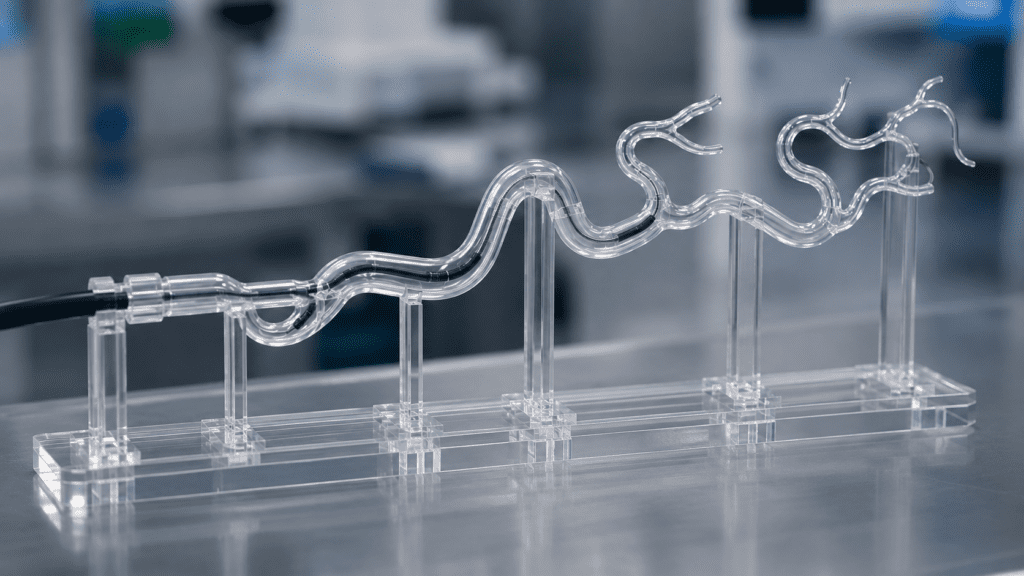
Neurovascular anatomy presents some of the most demanding design challenges in medical device development. Catheters must travel long distances through highly tortuous vessels, reach challenging anatomy, maintain lumen integrity, and perform reliably within aggressive profile and performance constraints.
Successful thrombectomy catheter development is rarely about maximizing one feature. More often, it is about balancing a series of competing requirements and making smart engineering tradeoffs throughout the development process.
The Continued Evolution of Mechanical Thrombectomy
Mechanical thrombectomy has evolved rapidly as physicians have gained more experience treating large vessel occlusions and other neurovascular conditions.
Today’s procedures commonly utilize aspiration catheters, stent retrievers, distal access catheters, guide catheters, microcatheters, and supporting delivery systems. Each component plays an important role in procedural success.
As physicians push for faster access, more distal reach, and improved outcomes, device developers face increasing pressure to deliver catheters that are both highly navigable and highly capable.
Unfortunately, those objectives don’t always align.
The features that improve one aspect of performance often create challenges elsewhere in the design.
Aspiration Catheters and Stent Retriever Systems
Many thrombectomy procedures rely on aspiration catheters, stent retrievers, or a combination of both.
Aspiration systems generally benefit from larger lumens that can help maximize aspiration performance. However, increasing lumen size often creates challenges related to flexibility, shaft construction, and distal navigation.
Stent retriever systems place different demands on the catheter. Delivery catheters and microcatheters must provide excellent trackability while maintaining enough support for deployment and retrieval of the device.
Regardless of the treatment approach, the underlying engineering challenge remains similar:
How do you create a catheter that can travel farther into difficult anatomy without sacrificing support, control, or reliability?
Distal Access Continues to Drive Design Innovation
One of the most noticeable trends in neurovascular device development is the desire for greater distal access.
Physicians want to reach target vessels quickly and confidently. That requires catheters that can navigate sharp bends and complex vessel pathways while maintaining support for downstream devices.
This creates a difficult balancing act.
A catheter that is extremely flexible may track well but lack sufficient support.
A catheter optimized for support may become difficult to navigate through tortuous anatomy.
Finding the right balance often requires multiple rounds of prototyping, testing, and refinement.
In many cases, small changes to materials, reinforcement structures, or shaft construction can have a significant impact on overall performance.
Trackability, Pushability, and Kink Resistance
When discussing neurovascular catheter performance, three characteristics are consistently at the top of the list:
- Trackability
- Pushability
- Kink resistance
Trackability refers to how well a catheter follows a guidewire through challenging anatomy.
Pushability refers to how efficiently force is transferred from the physician’s hand to the distal tip.
Kink resistance refers to the catheter’s ability to maintain lumen integrity while navigating bends and curves.
The challenge is that improving one characteristic can sometimes negatively impact another.
Increasing flexibility may improve trackability but reduce pushability.
Increasing stiffness may improve support but make navigation more difficult.
This is where catheter construction becomes critically important.
Catheter Shaft Construction Matters
Many of the most important performance characteristics of a thrombectomy catheter are determined by the design of the shaft.
Reinforcement structures, material selection, wall construction, and transition zones all influence how the catheter behaves during a procedure.

Traditional braided and coiled shaft constructions remain widely used throughout the industry. However, as developers pursue larger lumens, longer reach, and improved deliverability, more advanced construction techniques are increasingly being explored.
One example is back braiding.
Back braiding is often associated with other minimally invasive devices that require an atraumatic distal end. For example, the technique is commonly used in certain braided stents, embolic protection devices, and filter-based implants where reinforcement or structural elements need to terminate smoothly without creating exposed wire ends. Similar principles can sometimes be applied in catheter construction when engineers are trying to achieve specific performance characteristics while maintaining a soft, atraumatic distal region.
Back braiding can be used to selectively place reinforcement within portions of a catheter shaft to help create targeted performance characteristics that may be difficult to achieve using conventional construction methods alone. In some applications, this approach can help balance flexibility, support, kink resistance, and lumen preservation within highly demanding neurovascular designs.
The optimal construction method will vary from one device to another, but advanced reinforcement techniques can provide engineers with additional tools when conventional approaches reach their limits.
Material Selection Is About More Than Performance
Material selection plays a major role in thrombectomy catheter development.
Most neurovascular catheters utilize multiple materials throughout the shaft to create gradual transitions from the proximal end of the device to the distal tip.
Engineers must consider factors such as:
- Flexibility
- Tensile strength
- Bondability
- Lubricity
- Biocompatibility
- Sterilization compatibility
- Manufacturing consistency
Material choices made early in development can significantly impact both device performance and manufacturability.
The best-performing material isn’t always the best long-term solution if it creates supply chain challenges or manufacturing variability.
Hydrophilic Coatings and Device Navigation
Hydrophilic coatings are commonly used to reduce friction during catheter navigation.
A well-designed coating system can improve deliverability, reduce insertion forces, and enhance physician handling.
At the same time, coatings introduce additional development considerations, including durability, shelf life, packaging interactions, and manufacturing validation.
Developers should evaluate coating strategies early in the design process rather than treating them as a final design enhancement.
Visualization and Radiopacity
Visualization remains essential during any neurovascular procedure.
Physicians need to know exactly where a catheter is located while navigating sensitive anatomy.
Radiopaque markers and other visualization features help provide that confidence.
The challenge is integrating these features without negatively impacting flexibility, profile, manufacturability, or overall device performance.
As with many aspects of catheter design, success often comes down to balancing competing requirements.
Catheter Tip Design
The distal tip is one of the most important features of any neurovascular catheter.
The tip must navigate delicate anatomy atraumatically while maintaining compatibility with guidewires, aspiration systems, and other procedural devices.
Even small changes to tip geometry, material selection, or construction methods can significantly influence procedural performance.
As a result, tip development often requires extensive testing and refinement throughout the development process.
Designing for the Entire System
A thrombectomy catheter does not operate independently.
It must function as part of a larger procedural system that may include guide catheters, microcatheters, guidewires, aspiration pumps, and additional accessories.
Developers who focus only on the catheter itself sometimes discover integration challenges later in development.
System-level testing can help identify potential issues earlier and provide a better understanding of how the device will perform in real-world use.
Designing for Manufacturing from Day One
Many catheter concepts perform well during early prototype builds.
Far fewer perform equally well when production volumes increase.
For this reason, manufacturability should be considered from the beginning of the development process.
Questions worth asking early include:
- Can this design be manufactured consistently?
- Can critical dimensions be controlled?
- Is the process scalable?
- Are materials readily available?
- Can the design support commercial demand?
Addressing these questions early often reduces risk, shortens development timelines, and minimizes costly redesign efforts later.
From Prototype to Commercial Production
The transition from prototype development to commercial manufacturing is often where catheter programs encounter their greatest challenges.
Processes that work well for a handful of development units may not provide the consistency required for larger production volumes.
Successful commercialization requires close collaboration between design engineering, manufacturing engineering, quality, and supply chain teams.
Programs that incorporate manufacturing considerations early are generally better positioned for a smoother transition to production.
Supporting Neurovascular Device Development
Developing a successful thrombectomy catheter requires expertise in catheter design, materials, shaft construction, manufacturing processes, testing, and scale-up.
At Medical Murray, we work with medical device companies throughout the development lifecycle, from early feasibility and prototyping through verification testing, process development, and commercial manufacturing.