
Catheter-based procedures continue to move deeper into the body, into smaller vessels, and toward more complex anatomy. Physicians are treating conditions through less invasive access points, navigating more difficult pathways, delivering more advanced therapies through smaller, more advanced devices.
That is why catheter miniaturization matters. Smaller catheters support less traumatic placement procedures, expanding treatment options for medical professionals and their patients.
Despite all of the benefits, catheter miniaturization comes with its own unique set of challenges. Making a catheter smaller is not as simple as scaling down the same design. As catheter profiles shrink, every facet and function of the device’s design competes for less available space. Any loss in effectiveness can have dramatic consequences for patient care. Factors like flexibility, torque, and wall thickness need to operate within more limited constraints – all while retaining a manufacturing-friendly design.
Striking that balance is no easy feat, but it’s a critical part of modern medical device manufacturing.
Why Are Catheters Getting Smaller?
The move toward smaller catheter profiles is driven by several clinical and technical needs.
Less invasive access
Smaller devices can help reduce the size of the access site and may reduce tissue trauma during a procedure. More broadly, minimally invasive approaches are associated with smaller access points, reduced pain, fewer complications, and faster recovery compared with more invasive surgical approaches.
Access to smaller and more difficult anatomy
Many catheter-based therapies require navigation through small, tortuous, or delicate anatomy. This is especially important in areas such as neurovascular, structural heart, electrophysiology, peripheral vascular, pediatric, and other interventional procedures.
In these applications, the catheter must often travel farther, turn tighter, and reach more precise targets while still giving the physician control.
Better procedural options
Lower-profile catheters can make procedures possible for patients with smaller anatomy, challenging access routes, or higher procedural risk. They can also help physicians reach targets that may be difficult or impossible to access with larger systems.
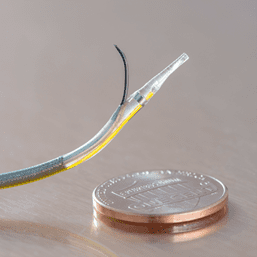
Most Catheter Miniaturization is Evolutionary
In most catheter manufacturing programs, size reduction happens through steady engineering refinement. The team may reduce wall thickness, improve material selection, adjust braid or coil reinforcement, optimize bonding methods, tighten extrusion tolerances, or simplify the device architecture.
These changes can be powerful, but they usually involve tradeoffs.
A smaller shaft may improve access but reduce pushability. A thinner wall may improve profile but reduce kink resistance. A larger inner lumen may improve flow or device delivery but weaken the catheter body. More reinforcement may improve torque response but increase stiffness. A softer distal section may improve safety but make device delivery more difficult.
This is the normal work of catheter miniaturization: balancing competing requirements until the smallest practical design can still meet the clinical need.
Why Smaller Catheters are Harder to Build
Miniaturization creates a practical engineering problem. As the device gets smaller, the margin for error gets smaller too.
Wall thickness gets squeezed
A catheter may need an inner liner, outer jacket, reinforcement layer, radiopaque features, bonding zones, coatings, and one or more working lumens. In more complex devices, it may also need pull wires, sensor wires, electrical conductors, hypotubes, marker bands, or implant delivery features.
As the outer diameter gets smaller, there is less room for every one of these elements.
This creates difficult design choices:
- How much wall thickness is needed for strength?
- How large does the lumen need to be?
- Where can reinforcement be added without making the shaft too stiff?
- How can the distal end remain soft while the proximal shaft remains supportive?
- How can visibility be improved without adding too much bulk?
At small profiles, every thousandth of an inch matters.
Performance requirements do not shrink
A smaller catheter still needs to work. Physicians still need the device to track, push, turn, deliver, deploy, and withdraw safely.
Depending on the application, the catheter may need to maintain:
- Pushability
- Trackability
- Torque response
- Kink resistance
- Tensile strength
- Burst pressure
- Flow rate
- Lubricity
- Radiopacity
- Tip flexibility
- Deployment accuracy
- Dimensional stability
This is one of the biggest challenges in miniaturization. The device gets smaller, but the performance expectations often stay the same or increase.
Material selection becomes more important
Smaller catheters often require more sophisticated material choices. Engineers may need to combine low-friction liners, reinforced shafts, soft distal segments, radiopaque materials, lubricious coatings, and precision metallic components.
Common design choices may include:
- Pebax, polyurethane, nylon, PTFE, FEP, or other catheter polymers
- Stainless steel or nitinol braid and coil reinforcement
- Radiopaque fillers, marker bands, or loaded polymers
- Hydrophilic or other lubricious coatings
- Laser-cut hypotubes or precision metallic components
- Thermal bonds, adhesive bonds, or reflowed shaft constructions
At smaller sizes, the processing window becomes less forgiving. A small change in material behavior, bond quality, or reinforcement pattern can have a large effect on device performance.
Manufacturing tolerances get tighter
Miniaturized catheters often require precision extrusion, tight dimensional control, micro-assembly, laser processing, reflow, bonding, tipping, coating, inspection, and testing.
As features get smaller, normal manufacturing variation can become unacceptable.
For example:
- A slight change in wall thickness can affect lumen size or burst pressure.
- A small bond inconsistency can create a weak point.
- A minor braid or coil variation can affect torque and flexibility.
- A small coating defect can affect friction or particulate risk.
- A slight marker band placement error can affect visualization or deployment accuracy.
This is why smaller catheters require strong process development, not just strong product design.
Assembly becomes harder to control
Many complex catheters are built from multiple small components that must be aligned, bonded, laminated, welded, or assembled into a single device. As components shrink, handling and inspection become more difficult.
The smaller the catheter, the more important it becomes to control:
- Fixture design
- Operator technique
- Bonding parameters
- Material handling
- In-process inspection
- Tooling repeatability
- Environmental controls
- Documentation and traceability
A prototype may prove that the design can work once. Manufacturing development proves that it can be built repeatedly.

Testing becomes more demanding
Smaller catheters still need to be tested against demanding requirements. Depending on the device, testing may include dimensional inspection, tensile testing, leak testing, burst testing, kink testing, torque testing, coating durability, particulate testing, simulated use testing, sterilization validation, packaging validation, and biocompatibility evaluation.
Miniaturized devices can be harder to fixture, measure, and test repeatably. In many programs, the test methods need to be developed alongside the device and manufacturing process.
Design changes become more expensive later
In a miniaturized catheter, a small design change can affect the entire system. Changing a shaft diameter, liner thickness, braid pattern, tip material, marker location, or bond length may affect performance, tooling, suppliers, inspection methods, and validation strategy.
That is why design-for-manufacturing input is so important early in development. The earlier the team understands the manufacturing risks, the easier it is to make smart design decisions before the device is locked.
The Next Frontier: Technologies that Challenge Definitions of “Small”
It’s true that most catheter miniaturization is evolutionary. But some emerging technologies may cause dramatic shifts in how catheters are designed and manufactured. These technologies are still developing, and many are not yet standard clinical or manufacturing platforms. Still, they point toward an important future: the smallest catheters may not simply be thinner versions of today’s devices. They may use new forms of actuation, sensing, navigation, and structural support.
Magnetically steerable catheters
Magnetically steerable catheters use external magnetic fields to help steer or control the device. This can move some actuation outside the catheter body, potentially reducing the amount of mechanical hardware required inside the shaft. Reviews describe magnetic catheter systems as an active area of research for minimally invasive applications.
The potential benefit is clear: if less steering hardware needs to fit inside the catheter, the device may be able to become smaller, softer, or more flexible.
Robotic and self-steering catheters
Robotic catheter systems may eventually help catheters navigate anatomy with more precise distal control and less reliance on manual manipulation from the proximal end. Some systems focus on active steering, sensing, or branch selection in difficult anatomy.
For miniaturization, the opportunity is not just automation. The opportunity is changing how navigation is achieved. If the catheter can steer more intelligently at the distal end, it may not need as much shaft stiffness, support, or layered mechanical complexity.
Concentric tube robots
Concentric tube robots use nested, pre-curved elastic tubes, often made from superelastic materials such as nitinol, to create steerable shapes from small structures. Reviews describe these systems as promising for minimally invasive surgery because of their compliance, controllable mechanical properties, and miniaturization potential.
This is an important concept for future catheter design. Instead of using a traditional polymer catheter shaft with multiple layers, pull wires, reinforcement, and jackets, a concentric tube system may use thin-walled metallic tubes to create controlled movement through small anatomy.
Variable-stiffness catheters and guidewires
One of the hardest problems in miniaturization is balancing flexibility and support. A device needs to be flexible enough to navigate safely, but stiff enough to transmit force and maintain control.
Variable-stiffness technologies attempt to solve this by allowing a device to be flexible during navigation and stiffer when support is needed. Research in flexible surgical robots highlights this same contradiction: high flexibility helps reach deep anatomy through small access points, but higher stiffness is needed for force transfer and motion accuracy.
If variable stiffness becomes more practical in catheter systems, smaller devices may be able to provide support only when needed rather than being oversized for worst-case conditions.
Soft robotic and sensing-enabled microcatheters
Soft robotic catheter concepts may use magnetic actuation, embedded sensing, or other advanced control methods to improve navigation and tissue interaction. Recent research has described small-scale magnetic soft robotic catheters with integrated force sensing for active steering and contact feedback. (ScienceDirect)
This could matter because smaller devices leave less room for error. If a catheter can sense force, contact, or position more effectively, it may be able to navigate delicate anatomy with less reliance on large mechanical safety margins.
Flow-assisted or body-powered navigation
Some future devices may use the body’s own forces to help with navigation. For example, a device could use blood flow, pressure gradients, or other natural fluid movement to help move or position part of the system.
This is a different way to think about miniaturization. Instead of asking the catheter shaft to provide all the push, torque, and steering force, the device may use the environment to assist with movement.
Microrobots and semi-tethered devices
Farther out, microrobots and semi-tethered devices may change the definition of a catheter altogether. Instead of pushing a long tube through the body, a catheter may become a delivery platform for much smaller tools that can navigate locally, respond to magnetic fields, carry sensors, or perform targeted tasks.
These technologies are still early, but they are important to watch. They suggest that the future of catheter miniaturization may come not only from making traditional catheter shafts smaller, but from rethinking the architecture of the device.
How to De-risk a Miniaturized Catheter Program
Whether the miniaturization strategy is evolutionary or more disruptive, the development process needs to be disciplined.
Start with the clinical need
Smaller is not automatically better. The device should be designed around the anatomy, access route, physician workflow, and therapy requirements. A smaller catheter that cannot deliver the therapy safely or reliably is not an improvement.

Define the critical requirements early
The team should identify which requirements matter most. Is the primary driver outer diameter, lumen size, flexibility, torque, pushability, burst pressure, visualization, deployment accuracy, or another performance requirement?
Miniaturization requires tradeoffs. The team needs to know which tradeoffs are acceptable.
Build and test early
Catheter development usually requires multiple design-build-test cycles. Early prototypes help the team learn what is possible before the design is locked. In some programs, larger-scale prototypes may be useful early to evaluate mechanisms before moving to the final catheter profile.
Involve manufacturing early
Miniaturized catheter design should not be separated from manufacturing strategy. Materials, tooling, process controls, inspection methods, operator technique, and supplier capabilities all influence what can be built reliably.
Plan for scale-up
A catheter that can be built once in an engineering lab may not be ready for repeatable manufacturing. Scale-up requires process controls, trained operators, validated equipment, inspection methods, supply chain readiness, and documentation.
Medical Murray’s Expertise in Miniaturized Catheter Manufacturing
Medical Murray specializes in complex catheters, implants, and interventional devices. For miniaturized catheter programs, our team helps customers move from concept to manufacturable product by combining catheter engineering, process development, cleanroom manufacturing, testing, and quality system discipline.
We help customers answer the practical questions that determine whether a small-profile catheter can be built reliably:
- Can the catheter meet the required profile and still perform?
- Which materials and reinforcements are appropriate?
- What process steps create the highest manufacturing risk?
- How should the device be inspected and tested?
- What design choices will make scale-up easier or harder?
- What needs to be proven before design verification or pilot production?
Catheter miniaturization is one of the most important trends in interventional medicine. It enables less invasive procedures, access to more challenging anatomy, and therapies that may not be practical with larger systems.
But smaller catheters require more than smaller components. They require careful design, precise manufacturing, and a development partner that understands how small changes can have large consequences.
Medical Murray helps customers build complex catheter technologies that are not only innovative, but manufacturable. Contact us today to get your medical device manufacturing project started.